
Waynesville history presented in Connections with the Past by our former Genealogy Librarian, Karen Campbell.
Local Businesses
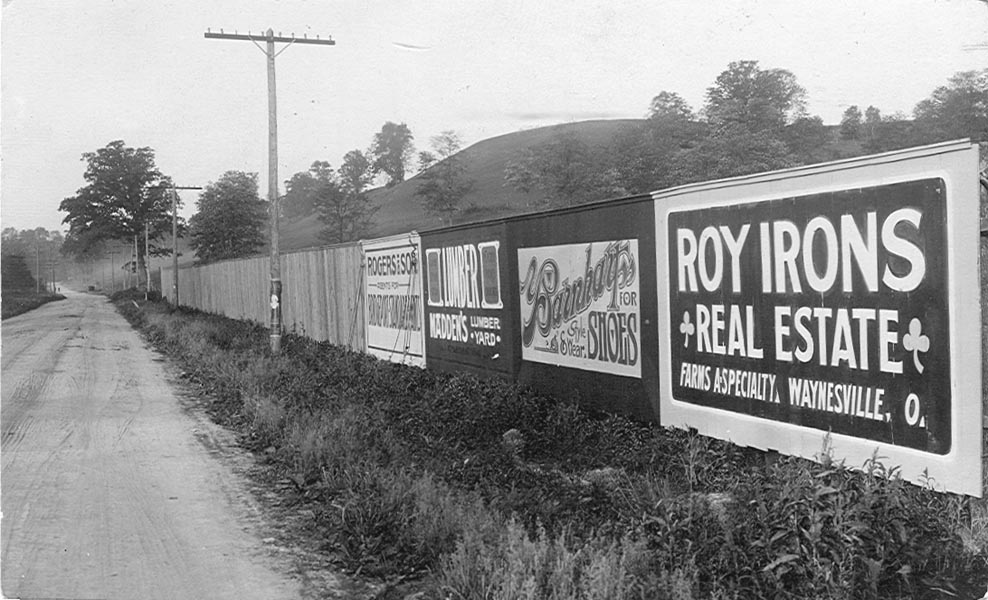
Roy Iron's Real Estate
The following is taken from the Souvenir and Home Coming Edition of the Miami Gazette dated December 1905, p. 2:
"Leroy Irons, General Insurance, Real Estate and Loans~ Leroy Irons, with offices in the Stoops Building, carries on an extensive insurance business, in his special lines of fire and cyclone insurance. Mr. Irons represents some of the strongest insurance companies in the world, in fact he has made it a point to represent none but first class companies that will settle all losses promptly and satisfactorily. Mr. Irons gives personal attention to all business in this line that comes to him, and always makes the best possible rates to customers consistent with issuing to them insurance that will insure. He has given special attention to farm insurance, and has the exclusive agency for the largest company in the world, interested in insuring farm property, 'The Home Insurance Co., of New York.' Other companies represented, all of which are strong and thoroughly reliable, are: The Aetna, National of Hartford, Norwich Union, Fire Association of Philadelphia, North British and Merchantile and Queen.
Mr. Irons is a genial, pleasant gentleman and has a wide acquaintance, both of which facts have no doubt contributed largely to his success in business. Also real estate; and loans negotiated. Valley 'Phone 77."
The following obituary for Leroy Iron was found in a local scrapbook. Unfortunately, the hand written date on the obituary is not clear ~ 12-13- ?. The other surrounding obituaries in the scrapbook are dated in the 1950s. The obituary has probably been clipped from the Western Star newspaper of Lebanon:
"Funeral services for Leroy Irons, 80, who died Monday afternoon at his home in Clyde, will be held Thursday afternoon at 2 o'clock at the Fiser Funeral Home in Clyde with burial in that city. Mr. Irons was a former resident of Lebanon. He is survived by his wife, Lena, a sister, Mrs. Ruth Brown of St. Louis, Mo., and a nephew, Albert Reed of Miamisburg."
Barnhart's for Shoes
The following is taken from the Souvenir and Home Coming Edition of the Miami Gazette dated October 1906, p. 46:
"An exclusive shoe store is something of a novelty in a town of less than a thousand inhabitants. Waynesville, however, can boast not only of an exclusive shoe store, but of a thoroughly up-to-date and successful line ~ Barnhart's Exclusive Shoe Store, located in the Aman Block. E. V. Barnhart (Ephraim V.), proprietor of the store, has been in the shoe business since he was a boy and understands the shoe trade form beginning to end. Like a number of other successful Waynesville boys, Mr. Barnhart gained his first knowledge of the shoe business back in the days when S. D. Everly kept a clothing and shoe store in Waynesville. After graduating at the local High School, Mr. Barnhart went to Dayton where he secured a through business training at the well known Miami Commercial College. From there he went into one of the leading shoe stores of Dayton and later on was connected with a prominent firm in the same line at Denver, Colorado. Afterwards Mr. Barnhart finished off his education in the shoe business by going on the road as a traveling salesman, giving up that position to open his store at Waynesville, five or six years ago. Mr. Barnhart handles everything in the way of footwear, but nothing else. At this store everything from an ordinary plow shoe to the highest quality of ladies' or gentleman's fine shoes may be had. His stock is very large and carefully selected, and in addition to the foregoing a full line of rubbers and rubber boots is carried . . . Mr. Barnhart takes foremost rank among the progressive business men of the community. He is a careful reader of the leading trade journals in his line, believes in modern methods of stock keeping and store arrangement, has attractive window displays, and fresh, crisp advertisements in the newspapers."
Ephraim V. Barnhart (February 27, 1873- December 6, 1946) was first married to Lou Marie Barnett Barnhart (1872-1929), the daughter of Charles Warren Barnett (1847-1920) and Emma Barnett (1849-1942) of Waynesville. According to the Federal Censuses of 1900, 1910, and 1920, the Barnharts lived with Lou Marie's parents. They are buried together in Section M of Miami Cemetery in Corwin.
E. V. Barnhart's obituary is in the Miami-Gazette dated December 12, 1846:
"E. V. Barnhart Called Friday ~ Ephraim V. Barnhart, aged 74, passed away at his home in Waynesville on Friday evening at 7:30 o'clock after an illness of about six months. More familiarly known as E. V., Mr. Barnhart had operated a shoe store here for many years prior to the 1920s in a location now occupied by Smith's Tea Room. He then went to Cincinnati where he was connected with the income tax department for several years as an accountant, later returning to Waynesville shere he has resided since. He was a member of St. Mary's Episcopal church, The Masonic Lodge, and Clerk of the Wayne Township School Board.
He is survived by his wife, Catherine, a brother Lyall of Oklahoma City, Okla., and a sister Mrs. R. W. Stultz of Winter Park, Fla. Funeral services were conducted at the McClure Funeral Home, Monday at 2:00 P.M. with Rev. Ralph Parks of Dayton and Samuel N. Keys, Lay reader-in-charge of St. Mary's Church officiating. Burial was made in Miami cemetery."
Madden's Lumber Yard
The following is taken from the Souvenir and Home Coming Edition of the Miami Gazette dated October 1906, p. 69:
"W. H. MADDEN & CO., DEALERS IN LUMBER ~ During the year and a half in which the firm of W. H. Madden & Co. has been in business at Corwin they have built up a substantial trade in lumber and allied lines. The firm of Madden & Co. is not new to the lumber business as the gentlemen who compose the company have had a wide experience in all the various branches of the lumber industry. Madden & Co. have for a number of years been in business at Clarksville and the growth of their trade led them to establish a lumber yard and sales office at Corwin. The advantages which come from buying in large quantities for two lumber yards are evident and the special low prices which they obtain in this way allows them to give their customers greater value for less money than would b e possible otherwise. The firm's headquarters in Corwin are located int he large building just north of the Post Office belonging to the H. Kilbon estate, and is in charge of W. H. Madden, who has proven himself a most capable and honorable business man. Pine lumber, lath, shingles, flooring, siding, doors, glazed sash, mouldings and the celebrated Napoleon elastic plaster are in stock at all times. A cordial invitation is extended to all who may be in need of anything in this line to call."
The Waynesville Brewery
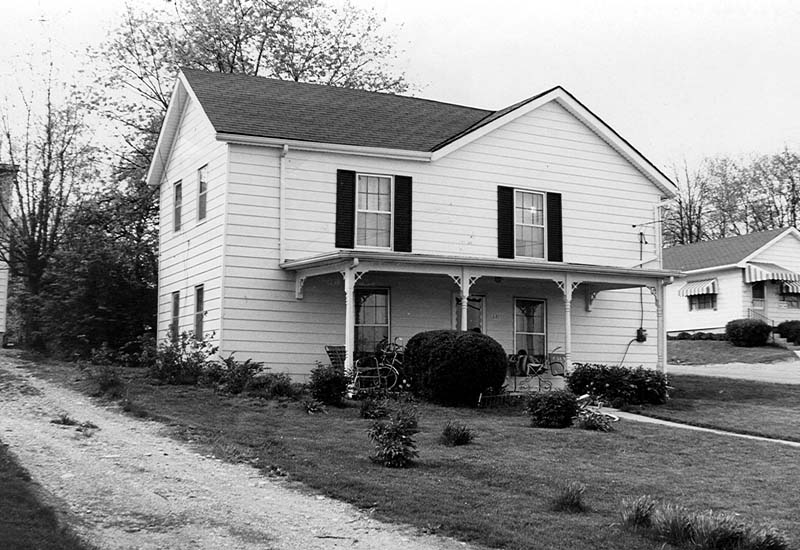
The Old Distillery Brewery. Corner of Franklin and North Main Street. Underneath this exterior is a log house built about 1801.
Roadside Advertising Near Waynesville about 1910
Near Waynesville ~ ca. 1905-1910
Clarence Bennett Bentley - Live Stock Dealer & Abraham Lincoln King - Farmer
12 Hogs. Raised by A. L. King. Age 7 months. Average Weight 240. Best ever bought by Clarence Bentley. The postcard photo dates from around 1910. 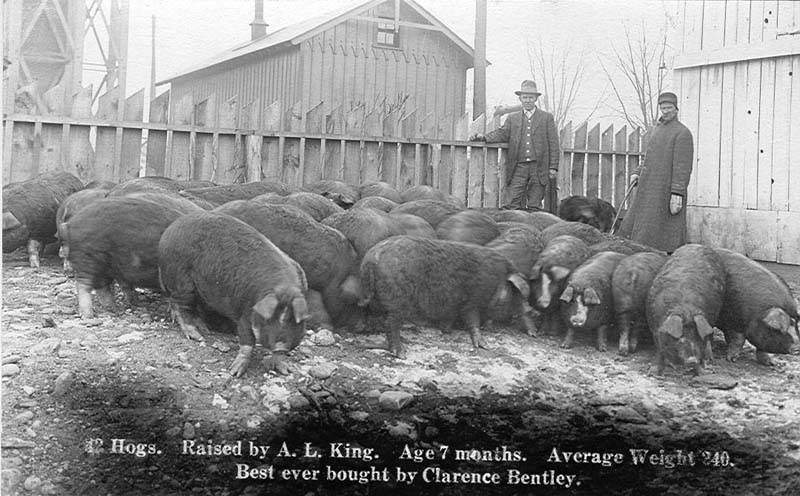
The photograph above illustrates the importance of the very lucrative pork industry in this area even up into the early 20th century.
A. L. King in the photograph is Abraham Lincoln King (the man with the long coat on). He went by "Lincoln King". He was born on July 16, 1859 and died November 8, 1946. He was 87 years old, 3 months and 22 days when he died. His father was William King (1827-1898) and his mother was Sarah Sabin King (1832-1906). His mother was born near Center Monthly Meeting in Clinton co., Ohio and his grandfather, William Sabin (1803-1869), was a noted Hicksite preacher (1903 Centennial Atlas of Warren County, Ohio, p. 23). Sarah King (formerly Sabin) was disowned from Quaker meeting for her marriage contrary to discipline to William King on December 24, 1856 (Hinshaw's Encyclopedia of American Quaker Genealogy, Vol. V., Ohio, p. 116). The Kings were not Quakers.
Lincoln King was married to Izora Hawke. Her parents were Silas P. Hawke an Mary E. Thomas Hawke. Izora was born on September 3, 1862 in Harveysburg, Ohio and died on February 3, 1933 at the age of 70 year, 5 months and 28 days. They are both buried in Miami Cemetery. Izora Hawke King is buried in Hawke burial plot in Section K (End of Drive Turn-around). Abraham L. King is buried by himself in the inverted "V" at the entrance to Section K. Lincoln King was a farmer all his life.
Clarence Bennett Bentley (man leaning against the fence), who was a live stock dealer in Waynesville, died when he was only 46 years old. He died on September 3, 1921 in Blanchester, Clinton Co., Ohio. He died of cerebral embolisms due to an injury to the base of his skull. He was married to Nina Erma Smith Bentley who was almost half his age. She was 24 in 1920. Clarence is buried in Miami Cemetery, Section P. After Clarence's death, Nina married Will C. St. John and became Nina E. St. John. Will and Nina St. John are buried close to Clarence Bentley in the same section. On his World War I Registration Card, Clarence is described as tall with a medium build with blue eyes and light hair. He was 44 years old when he registered.
The Mary L. Cook Public Library
88 Years of Responsible Growth and Community Service
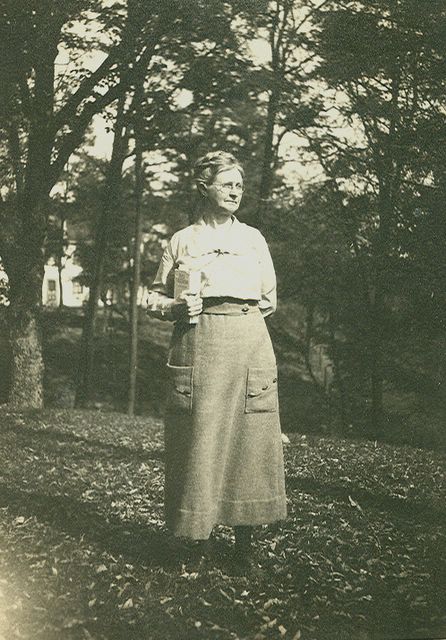
Dr. Mary Leah Cook said that her greatest thrill has been: “Watching little children march into the library and take out books.” Dr. Mary Leah Cook (b. September 25th, 1869 ~ d. March 31st, 1964), much-loved physician of Waynesville, Ohio cared for people, not only their physical health but also their intellectual and spiritual health. An avid reader and life-long learner herself, she encouraged the same in others. Like most professional people, she had a library of her personal books in her doctor’s office and would lend out books to people to read. One day she decided to start a library. So, in 1917, Dr. Mary L. Cook along with other civic-minded persons decided to establish a library for public use in Wayne Township in the village of Waynesville, Ohio. Earlier attempts had been made to establish a permanent library in Waynesville but were not long lasting or were private/religious collections:
John Satterthwaite (1786-1837), an early Quaker pioneer and businessman, was the librarian of a collection of books that eventually was destroyed in a fire on Main Street in the early 1800s.
John Wesley Roberts (1824-1900), a Methodist preacher, author and the publisher of the Miami-Visitor weekly newspaper, fought valiantly between 1850-1861 to establish a subscription library and literary society, but these efforts proved to be only temporary.
Another notable Methodist minister, Rev. Samuel Scott (1819-1909), who founded 328 subscription libraries throughout the Midwest tried to establish a library in Waynesville in 1879.
The Union Schoolhouse that was established in the late 1850s also had a school library. According to the School Act of 1853, tax monies could be used to establish libraries in schools and they were also to be open to use to the public.
The Waynesville Methodist Episcopal Church had a very large religious library of books in the 19th century.
Both the Orthodox and Hicksite Quakers maintained large religious libraries in Waynesville. The White Brick Hicksite Quakers even had a branch of their library in the Hicksite Quaker Meetinghouse in Harveysburg (Grove Meeting).
Many individuals had private libraries in their homes, but the establishment of a permanent library for the larger community that would stress ongoing adult education eluded the citizens of Wayne Township. However, there was a growing awareness and demand for higher education throughout Ohio commensurate with the development of centralized elementary and high school systems which in effect brought the one room district school house system to an end. The Wayne Township School System had been established in 1915 and a new school building built on Dayton Road in the west part of the village. Public education was available to everyone, so too should the benefits of a good public library. That this was in the minds of the organizers is illustrated by the presence of the school principal, E. J. Arnold, and the Waynesville School Superintendent, William Robert Spriegle, at the first organizational meeting.
Indeed, today most public libraries in Ohio are school district libraries although funding has been separate from school levies since the 1920s. If ever a project was started on faith, the Waynesville Library, afterward named The Wayne Township Library, certainly was. In 1917 a group of civic-minded public-spirited folks, mostly women who were interested in good reading for the community, began to have ideas that gradually evolved into a library. There goals were as follows to:
- Try to establish and maintain a library.
- Try to bring within the reach of the whole township pure and wholesome literature.
- Try to help in the formation of a taste for such literature in the public.
- To awaken public sentiment in favor of better library facilities in our community.
Foremost among these were Dr. Mary L. Cook, Miss May Wright, Mrs. Edith Mosher Harris, and Mrs. Georgia Frame Mendenhall. They had no building, no books and no money but they did have faith and a willingness to do all possible to make the vision a reality. This attempt worked due to the perseverance of Dr. Mary and her determination to do it right and that the library would be fiscally responsible and stable. On February 17, 1917 a number of people interested in starting a library met together in the high school auditorium for the purpose of forming a library association. Previously they had asked for a state library organizer to be present and at this time Mr. J. Howard Dice met with them. After his talk in which he gave them practical suggestions, they proceed to organize making Dr. Mary Cook president. She would be president for the next 43 years!
The library began as the Wayne Township Library Association. Any person living in Wayne Township of Warren County could belong to the Association for $1.00 annual subscription dues. With this money as well as fines collected, gifts from various businesses in the area and donations from individuals of supplies, books, magazines subscriptions and coal, the library first opened on Main Street in the old Harris bank building in 1917. In 1924 a resolution was read at a meeting of the Wayne Township Library Association and adopted that since the library served the community, the Board of Education of Waynesville should provide the management and control of the library in accordance with sections 7735-7640 of the General Code. On April 11th, 1924 the property held by the Library Association was duly transferred to the Board of trustees of the School Distinct Library, which would become known as the Wayne Township Public Library. The trustees of the old Association became the trustees of the new Board of Trustees of the school district ~ public library, the Wayne Township Public Library. Donations for the growing library, now located in the old Miami House on North Main Street, in the form of memorials and gifts continued as before which enhanced the funding from taxes through the school. For example, the Cartwright family of Waynesville was very generous, establishing a fund for children’s books and giving money for a new floor to be laid in the library. Another family that established a fund were the Aldens. Local families made other donations. A list of their names is a miniature history of the village: W. H. Allen, Jessie Clark, Frances Alden, D. H. Hockett, Georgia Mendenhall, Mary Frame, William T. Frame, Mrs. J. F. Cadwallader (Episcopalian minister’s wife), Dr. J. T. Ellis, Seth Cook (Dr. Mary’s father), Dr. Mary L. Cook, Dr. R Smith, Dr. J. W. Miller, Mr. and Mrs. S. L. Cartwright, Mr. and Mrs. J. O. Cartwright, May Wright (the first librarian), Evelyn Peterson, Minnie Dodson and John Fromm. Various organizations in the village and township made donations: the school itself, the Wayne Township Trustees, Miami Monthly Meeting of Friends, the Young Friends Group, the Farmer’s Club, Progressive Women, etc. The library has always benefited from generous private and corporate donations throughout the years.
The library moved in the summer of 1917 from the Harris Bank building to the Miami House on the northeast corner of North Main and North Street. While the library was still located on Main Street the State of Ohio passed legislation in 1933 to support public libraries through the Intangible Personal Property Tax. The “intangibles” taxed were primarily stocks and bonds. The tax was collected locally. Unfortunately, this method was not equitable and thus some locales in Ohio had wonderful libraries whereas others did not have any at all. In 1954 the Wayne Township Library moved from Main Street to the first floor of the old 1898 Union Schoolhouse on Fourth Street, which was owned by the American Legion Post #615. This move was made since the old school was in a residential area and thus more assessable to the children and families of Waynesville. Also, the library needed more room to expand. In 1961, in the midst of a children’s reading program, the Board had a brainstorm. Dr. Mary Cook, founder of the library and Board President until 1959, had visited the library one afternoon and in explaining to a newcomer the pleasure that was mutually derived from her visit, we suddenly knew that the name of the library must be changed from “Wayne Township Public Library” to the “Mary L. Cook Public Library”. And Right Now! After all, Dr. Mary was nearly 92, and all of us wanted her to know of the honor we were bestowing of her and she on us in letting us use her name. Again the library board was pressed into action and on July 23 we gave a reception for Dr. Mary and erected a beautiful sign with the new name of the library emblazoned in gold. The Library trustees met every month. In the 43 years of Dr. Mary’s tenure as President, they met 516 times. She was absent only 24 times during that time! An open house and public reception was held for Dr. Mary on Sunday, July 23rd, 1961 in recognition of her many years of devoted service to the library. In 1983, the State of Ohio repealed the old Intangible Personal Property Tax for libraries. It was replaced by the Library and Local Government Support Fund, which has striven to be more equitable in its distribution of funds. Its initial goals were to continue the support towards existing libraries and to encourage growth in the under-funded and under-serviced areas of Ohio. Plans began to be made to build a new library building in Waynesville in the early 1980s. A larger building was needed due to the lack of space and overcrowding, inaccessibility for the handicapped and elderly, and a lack of program/meeting areas. Although originally called the Wayne Township Library of Warren Co., Ohio, the library has always served a larger area. In 1983, the State Library of Ohio officially designated the library’s service area as follows: · Wayne Township, including the village of Waynesville · Clear Creek Township, eastern half to Bunnell Hill Road · Massie township · Washington Township, northern half to Ohio Rt. 350. Through the years the library has drawn patrons from Centerville, Xenia, Spring Valley, and as far as Wilmington. Renovation of the old Union Schoolhouse was considered but was rejected as too costly. For the first and only time in the history of the library, a bond issue ~ .9 mills for 22 years ~ was placed on the ballot and was approved by voters. The bond was paid off in half the time allotted. (Although the library is designated a “School District Library” it must be stressed that the Wayne Local School District does not contribute any funding to the library. The School District is the library’s “Voting Authority” meaning that the School Board assists the library by placing any library issues on the ballot.)
The construction of the new building on Old Stage Road began in September of 1987. The new building was opened to the public on June 3rd 1988. As Waynesville and the surrounding community continued to grow, the Library Board recognized that the facility they had built would soon become too small and crowded. The advent of computers and the Internet greatly impacted the way the library did business. In the early 1990s, the library created a Building Fund. By conserving funds and judicious spending, the Building Fund grew. In December 2000, the Library Board used a portion of the Fund to purchase two adjacent properties. With the properties secured, the Board was able to use the accumulated Building Fund to finance a 5,000 square foot addition to the library. No bond issue or levy was necessary, as through careful saving and investing, the library was able to finance the addition with monies in hand.
The Mary L. Cook Public Library is a vigorous educational institution to be proud of. It has avoided waste and has consistently increased its services to the public through out the years. It is safe to say that we will be here in another 88 years, still planning thoughtfully and prudently to serve the community in the ever-changing and ever-challenging world of the future.